
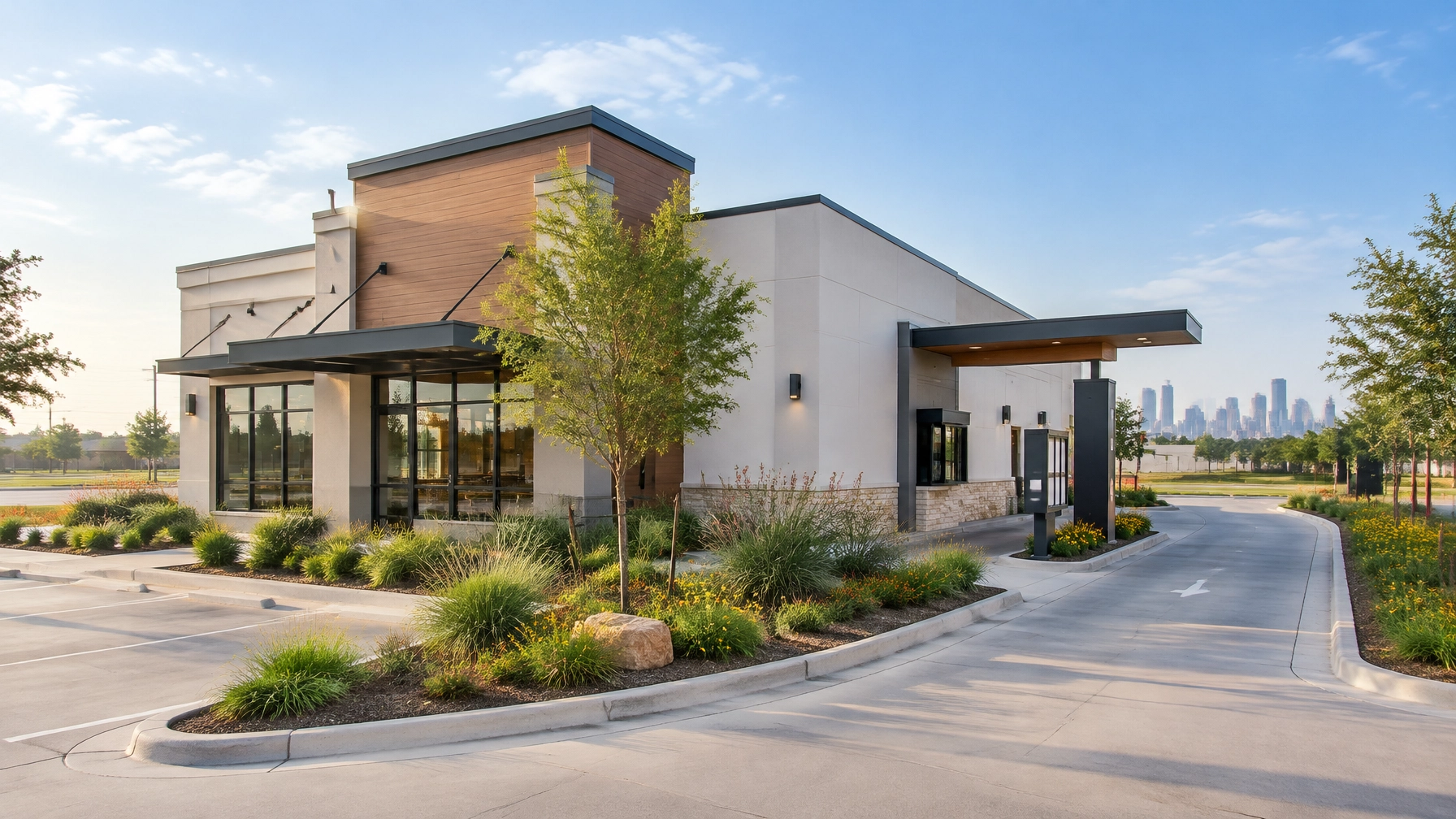
A single-tenant property can offer a straightforward way to invest in commercial real estate. The tenant occupies the building, and a triple net lease often assigns many property costs to that tenant.
But “hands-off” doesn’t mean risk-free. We’ll help you look past the advertised rent and evaluate the lease, tenant, building, financing, and Houston-specific costs before you make an offer.
Why NNN properties appeal to investors now
A single-tenant NNN property can appeal to small investors and family offices seeking predictable rent. Drive-thru restaurants, auto service centers, urgent care clinics, and medical offices are common examples.
In a typical NNN lease, the tenant pays rent and reimburses some or all property taxes, insurance, and maintenance. The exact duties depend on the lease. Roof, structure, parking, and major equipment may still create costs for you.
Investors are also watching yields reset. The Boulder Group’s Q3 2026 Net Lease Market Report puts national single-tenant asking cap rates at 6.69% for retail, 8.00% for office, and 7.28% for industrial. Its overall asking rate reached 6.92%, the highest in more than a decade. The 10-Year Treasury rose above 5% by September’s end.
These higher rates can create more room to negotiate. They can also make borrowing expensive. A higher advertised yield does not automatically make an asset a better investment.
Private investors and family offices remain active, especially for credit tenants and certain assets that may qualify for 100% bonus depreciation. Eligibility depends on the asset and current tax rules. Ask your tax professional before counting on a tax benefit.
How cap rates get set
A cap rate compares a property’s annual net operating income with its purchase price. It gives you a quick, unleveraged yield estimate. It does not tell you your return after financing.
Lease term is one of the biggest pricing factors. The Boulder Group’s Q3 2026 auto-parts data show asking cap rates of 5.65% with 16–20 years remaining, versus 8.27% with five years or less. That’s a 262-basis-point difference.
A long lease can support a lower yield because it may offer more income certainty. A short lease can mean near-term vacancy, renewal, or re-leasing costs. You still need to examine whether the tenant can pay, whether rent increases are sustainable, and what happens when the lease ends.
For context, the report lists auto service at 6.20% and collision properties at 6.67%. These are national asking benchmarks, not promises about a Houston property.

Houston pricing: compare carefully
Houston may offer higher yields than national single-tenant benchmarks, but comparisons need care. Lee & Associates’ Q3 2026 Houston retail report lists a 7.3% market cap rate. Its Houston industrial report lists 7.9%.
Those figures are above Boulder’s national single-tenant retail and industrial asking rates. But the reports may cover different property sets and methods. Treat the comparison as a starting point, not a direct valuation or an offer-price formula.
Houston activity is worth watching, too. The Institutional Property Advisors Houston retail report says single-tenant trades nearly doubled year over year through June 2026, driven mainly by properties priced from $1 million to $10 million.
When you review a net lease property for sale, compare similar property types, tenants, lease terms, guaranties, and locations. Our Houston commercial property evaluation guide walks through the broader due-diligence process.
Look beyond the tenant’s brand
A familiar logo isn’t the same as a strong lease guaranty. Confirm which legal entity signs the lease and whether a parent company guarantees it. Read the guarantee itself. Check its scope, duration, and enforceability with your attorney.
Review tenant financial statements and payment history when available. For an operating business, ask whether its revenue can support rent and other occupancy costs. Consider sales trends, margins, and upcoming rent increases. A strong tenant today still needs to afford the lease tomorrow.
Also read the lease line by line. Confirm who pays taxes, insurance, repairs, roof, structure, HVAC, and parking. Look for renewal options, termination rights, assignment rules, rent escalations, and caps on expense reimbursements.
Buying a sale-leaseback from the investor side
In a sale leaseback, a business owner sells an appreciated building and leases it back. The sale can convert real estate equity into capital for growth, debt reduction, or other business needs. The business continues operating from the site.
As the buyer, you acquire both the property and a landlord-tenant relationship. Don’t buy the rent stream alone. Ask whether the tenant can support its new rent and operating costs after the sale.
We recommend checking:
- Lease structure: Who pays each expense? Are there termination options, escalations, or renewal terms?
- Tenant credit: Is the operating company the tenant, or does a stronger parent provide a written guarantee?
- Rent coverage: Can the business comfortably pay rent from ongoing operations? Review actual financials and stress-test weaker sales.
- Residual property value: What could the building be worth or earn if this tenant leaves?
- Alternative uses: Could another operator use the site without major conversion costs?
A specialized building can be harder to re-lease. Underwrite downtime, repairs, tenant improvements, and marketing costs. Our rule is simple: buy the dirt and its future usefulness, not just today’s lease.

Houston checks you don’t want to skip
Before you pursue an nnn property for sale, investigate flooding and drainage at the specific address. Don’t rely on a map zone alone. Request the property’s flood and insurance-claim history, review available county drainage information, and ask an insurance broker for property-specific quotes.
Check the tax account and recent appraisal history with the Harris Central Appraisal District. Don’t assume the seller’s tax bill will stay the same after closing. Model taxes using the property’s actual details, and confirm how the lease handles increases.
Get current quotes for property, wind, and flood coverage. Review deductibles and exclusions, and confirm what the lease requires the tenant to carry. Even when a tenant reimburses insurance costs, coverage gaps, deductibles, and tenant default can still affect you.
Financing, DSCR, and an illustrative yield example
Lenders size a single-tenant loan around the property’s income and tenant risk. One Houston lender’s published financing benchmarks showed qualifying single-tenant net-lease rates near 6.9% in October 2026. That is an indicative quote, not a guaranteed rate.
Ask your lender about loan term, amortization, recourse, reserves, prepayment costs, and the required debt-service coverage ratio, or DSCR. DSCR compares property NOI with annual loan payments. A 1.25x DSCR means NOI must be at least 1.25 times annual debt service.
ILLUSTRATIVE ONLY, not a Houston valuation or forecast: Assume a hypothetical property costs $2 million and produces $150,000 in annual NOI. That equals a 7.5% cap rate. If you borrow $1.3 million at 6.9%, amortized over 25 years, annual debt service is roughly $110,000. DSCR is about 1.36x. Before taxes, closing costs, and other investment considerations, annual cash flow after debt service is about $40,000.
These numbers are simplified. Your lender may use different rates, expenses, and underwriting rules. Run a downside case for reduced rent, insurance increases, vacancy, and tenant default.

Make your next move with a local team
Your first NNN deal doesn’t have to feel overwhelming. We can help you compare leases, tenant strength, Houston locations, and financing assumptions before you commit. For more on houston real estate investing, see our Houston investing guide.
Some NNN properties may be eligible for a 1031 exchange, depending on your circumstances and professional advice. We recommend discussing tax questions with your qualified advisor.
Ready to review a property or explore a sale-leaseback? Schedule a free commercial consultation with Hou.co. Our team will help you take a clear, informed next step.